ProfessionalBackend Infrastructure2025Confidential
Notification Center
Centralized, observable infrastructure for asynchronous delivery
A production gateway for Email and Telegram notifications, separating API acceptance from asynchronous provider delivery through persistent state, queues, workers, and operational monitoring.
Selected details are omitted due to confidentiality.
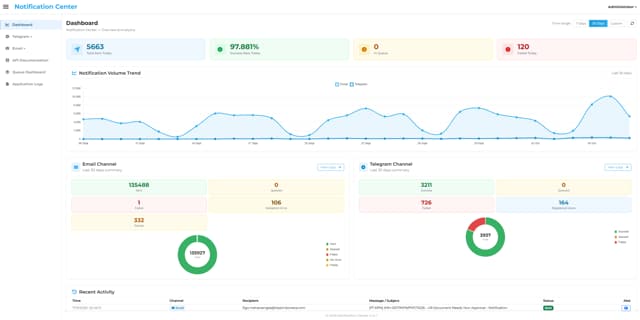
Overview
I designed and implemented Notification Center as a shared gateway for internal applications that need to send Email or Telegram notifications. Calling applications use one validated API boundary; provider work happens asynchronously; operators retain one durable place to inspect delivery state and failures.
Problem
Internal applications needed a common integration boundary for multiple notification channels. More importantly, the system had to preserve a distinction that synchronous integrations often blur: an API request accepted for processing is not yet a successfully delivered message.
Provider calls can be slow or temporarily fail. Recipient and attachment input must be bounded before delivery. Telegram requires a verified recipient-to-chat relationship. Operators also need to trace queue jobs and failures without exposing provider credentials to calling applications.
Architecture
API acceptance stays distinct from provider delivery and final operational state.
Internal applications
Submit validated Email or Telegram requests through one REST boundary.
Accept + persist
Normalize input, reject invalid work, create durable queued state and trace ID.
Redis-backed queues
Channel queues decouple caller latency from provider work.
Bounded workers
Apply concurrency, rate limits, retries, and exponential backoff.
Delivery state
Workers and reconciliation update sent, success, failed, or validation states.
Persistent record
Queue job IDs connect async work to searchable history.
Recoverable failures
Eligible work can be retried; stale or removed jobs become visible.
Operations
Authenticated dashboard exposes trends, logs, queues, and failure states.
Accepted Email work returns 202 Accepted only after a traceable record and queue job exist. Separate Email and Telegram workers call their providers and update the same persistent record with the final state. This keeps caller latency independent from provider response time while making the API contract honest.
Engineering Decisions
Persist state around queue boundaries
Validation failures are recorded before queueing; valid work receives a queued record before enqueue. Queue job IDs connect Redis work to MySQL history. Enqueue failure, delivery failure, removed jobs, and stale queued records are reconciled into explicit states instead of remaining ambiguous.
Bound provider pressure and recover transient failures
Channel workers use concurrency limits, configurable rate limits, and three attempts with exponential backoff. Failed jobs remain observable. Authenticated operators can retry eligible records; when a Redis job no longer exists, recoverable work can be rebuilt from persisted state.
Make recipient onboarding a controlled handoff
Telegram registration uses random, expiring, single-use tokens. The server-side access token is stored as a hash and consumed transactionally before a short-lived registration session binds the verified chat.
Operational Visibility
The dashboard aggregates period totals and daily trends from notification records. Operators can inspect Email and Telegram states, search and export logs, monitor both queues, and retry eligible failures. Ordered shutdown stops new HTTP work, pauses local processors, stops bot polling, then closes Redis and MySQL connections.
The visible 30-day production sample contains 96,562 sent Email events, 646 failed Email events, 95 validation errors, and 560 Telegram events. These figures demonstrate production use without implying unique users, perfect delivery, or permanent monthly volume.